Tuesday, 7 January 2014

Wader Quest - Guest Blog

 Spoon-billed Sandpiper

David Lindo and I go back a long way, all the way back to page 122 paragraph 2  in his entertaining book The Urban Birder where I am lovingly referred to as “… a birder in Cley…”. David and I have maintained a strong, albeit sometimes distant, bond since that day. It was David who gave me my first gig as a bird guide when he set up Capital Birding Tours many moons ago giving me a good grounding for my later bird guiding escapades in Brazil and it was he, while working at the BTO, who commissioned my first published artwork for the cover of a BTO publication. In truth I see more of David on telly than I do in person these days but this has not diminished our friendship one jot.

David and I often talk and run ideas past each other, most of his come to fruition and are successful, most of mine… not so much, nevertheless, David always listens and advises with friendly interest. When Elis and I had the idea for Wader Quest David’s reaction was ‘Go for it!” and that was all the encouragement we needed. Turning a decent deposit for a house into a year of travelling to raise funds for, and raise awareness about, the urgent need for wader conservation was a big step, but greatly encouraged by friends,  family and of course David, we embarked on our ambitious project.

 Andean Avocet

Elis and I had been working for five years in a voluntary capacity with children and schools in Brazil promoting conservation and preservation of the surrounding forests and I was doing some guiding.  In 2012 we returned to the UK and found that our desire to be making a difference was now well and truly rooted in us.

Initially we planned to raise funds for the Wildfowl and Wetlands Trust Spoon-billed Sandpiper captive breeding programme, but as we learned more, travelled further and encountered other desperate stories we felt that we should perhaps spread our wings a little. In August this year we took up the cause of the Hooded Plovers in Australia. BirdLife Australia (BLAus) lost its government funding so Wader Quest started to raise funds to donate to them to help them to continue the excellent work they have been doing with superb and very encouraging results; we continue to do so now.

 Black Stilt

We have travelled on the six inhabited continents since starting on November 1st 2012. We started in the UK with a trip to Titchwell, and it was that journey on the very first day, that made us already begin to think about the future direction of Wader Quest. We travelled up to Titchwell by car from Northampton, crossing ‘Fenland’ on the way. We had, reasonably we thought, expected that our first wader species would be Northern Lapwing, indeed we left after daybreak in order to maximise the chances of seeing this bird during the journey, but we didn’t. We arrived at Titchwell with a list of zero. Thirty years ago this would have been unthinkable. The decline in Britain’s most common wader by 50% in those thirty years was a stark reminder to us that wader conservation isn’t just about cute little birds with funny bills in the far flung corners of Asia, it’s also about here and now in the UK and every continent on earth. Waders of all kinds, from a variety of habitats from Steppes to the intertidal zones are facing greater and greater pressure put upon them by the demands of mankind.

During our travels to date we have seen 165 species of wader and not just the classic sandpipers and plovers, but obscure things like seedsnipe, coursers and jacanas that hardly look like waders at all. Among these birds there have obviously been some favourites and some real stars.

 Diademed Sandpiper
 Hooded Plover
 Kittlitz's Plover

Those species that reach star status include, rather inevitably, the Spoon-billed Sandpiper that started this whole thing off, the Diademed Sandpiper-Plover that you almost have to die to see at the top of the Andes, the Magellanic Plover at the end of the world in Tierra del Fuego, the Sociable Plover that we bumped into on its migration through the UAE, the aforementioned Hooded Plover of Australia, its close relative the Shore Plover of New Zealand and the rarest wader in the world, the Black Stilt, also of New Zealand.

But those birds are stars in part because of the plight they find themselves in, all are rare (three Critically endangered, one endangered, two near threatened and one vulnerable) and some of them with populations on the edge, only hanging on due to conservation initiatives and management.

 Magellanic Plover
 Northern Lapwing

However some less threatened species also captured our imaginations during the trips, perhaps for their appearance (White-crowned Lapwing) or their name (Kittlitz’s Plover), or maybe their value as a British rarity (Long-toed Stint) or simply the fact that it took two goes to see one (Andean Avocet). We had good days, like the day we saw eight new species in Australia and bad days spent trudging through horrendous weather to no avail; some good fortune like having a site for the nomadic Burchell’s Courser in South Africa and some dips, we never did catch up with Rufous Seedsnipe in Peru or Chile, but the thrill of being out there searching for the birds never diminished. We received a lot of help from local birders and researchers, including a map with ‘X marks the spot’ for Mountain Plover in California, some provided up to date gen, others came out with us to help us find the birds and in South Africa our road trip was privately sponsored by friends.

During our travels we have given talks at eleven venues, the total number of people reached is over seven-hundred helping to spread the word and raise awareness among birders and non-birders alike .

 Shore Plover
White-crowned Lapwing

As we are approaching the end of the travelling phase of the project our thoughts have turned to the future, what of Wader Quest now? Are we simply going to put away our passports, pay up the money we have raised for the WWT and BLAus and retire? Not a bit of it, we have the bit between the teeth now and the plan is to develop Wader Quest into a fundraising charity of some kind so that we can continue to raise money. The intention is to move the emphasis to providing grants to small wader conservation projects or to pay for specific items perhaps within a larger one, such as fencing or signage etc.

We were thrilled when in South Africa a group of people, inspired by what we are doing, set up Wader Quest South Africa, then, following suit this January, Wader Quest Brasil was born; we hope others are in the pipeline. Our ambition is that one day the message about wader conservation will be more widely heard and that it will become as high in profile as that of the conservation of the world’s rainforests. We hope that in some small way we and our friends around the world, in the name of Wader Quest, will have been influential in making a change for the better increasing the chances of survival for one of the most fascinating groups of birds on the planet, the waders.

Monday, 6 January 2014

Latvia in print

Female Red-breasted Flycatcher (Tom Mason)
Last May, I had an extraordinary birding experience in Latvia. Literally thousands of migrants all over the areas that I visited.

Read about it in a forthcoming edition of Bird Watching Magazine.

End of commercial break.


Friday, 3 January 2014

It's that time of year again

Mute Swans (Russell F Spencer)
It's a brand new year and as with the previous countless years, many vows are made ranging from trying to be a better person through to making more effort to go birding more frequently.

I'm not one for resolutions, but I am about to make one now. A very public one.

I vow to update this blog more frequently than what I did last year.

There. I've laid down the gauntlet for myself.

We'll see what transpires.

Merry New Year

Monday, 30 December 2013

London Calling!!

The 2011 London Bird Report
The latest LBR, as it is affectionately known, plopped onto my doormat last week. Being a London-based birder I am naturally very interested in learning about the avian occurrences in my home city. I have avidly studied the pages of the successive editions of the LBR for more years than I care to admit. Plus, during those years I managed to acquire even older LBR issues spanning back decades that documented breeding Red-backed Shrikes and floods of Black Redstarts.

One of the great things about the LBR is that it has finally caught up with the times. By that I mean that it is now only a couple of years behind - totally acceptable - compared to the hopelessly delayed production schedule of old. But even then, as it is now, the editorial content was superb. I'm pleased to say that in the 2011 edition, more than any other, were great images of common birds as well as a few of the rarities thrown in. In the past there was a over emphasis on the rare and exotic so it's really good to see that an effort has been made to attract ordinary birders to its pages.

The 2011 edition more or less follows the usual running order that this publication has historically followed: a list of the rarities committee and recorders, a breakdown of the recording area, a brief review of the year, a list of the contributors followed by the systematic list of the birds found in London during the year. This is the meat of the report. Usually, there is a sponsored colour plate section in the centre of the book. This year the images are sprinkled throughout the accounts. A much more pleasing arrangement if you ask me. My only gripe being that some the species images were often placed alongside the text of an unrelated species. I can't fault the editorial compilations and I have to compliment the editorial team for the obvious hard work that has gone into producing the species accounts.

Following the species listings are the appendices covering escapes, hybrids and non-proven records. They are in turn followed by a series of papers largely on the birds of individual sites as well as the results of ringing records and WeBS counts (the British Trust for Ornithology's Wetland Bird Survey). The LBR is one of the best annual bird reports in the land and is a great testament to the number of birds to be found in and around the capital. Proof that urban birding can be very rewarding, even in the heart of Britain's biggest city.

The London Bird Report is published by the London Natural History Society http://www.lnhs.org.uk/ priced at £8.00

Sunday, 29 December 2013

So near, but......

 The Scrubs: A view looking east from Braybrook Street
The last embers of 2013 are flickering, drawing to conclusion a year of contrasts for my beloved local patch, Wormwood Scrubs.

We have thus far had the joint best year for the most amount of species seen on and over the site - 98. All year we have been aiming for the magical 100 but it seems that we have a glass ceiling. Our efforts have been blighted by a fairly poor autumn despite finding a mega in the shape of a juvenile Common Rosefinch, London's first twitchable example for some three years. Add to that the disappearance of two of our best Scrubbers; one claimed by New Zealand and the other had a baby and emigrated to Suffolk. We are about to loose another to Sweden in January. Our team of birders is about to be severely depleted. We have had birders leave before in previous years and like when Eric Cantona left Manchester United, we still went on to find great birds and good year totals.

Perhaps the biggest threat to the fragile tranquility at The Scrubs has been the announcement this year that the area has come to the notice of a host of entities keen to turn the land immediately to the north  into a cityscape that according to the blurb, will resemble Manhattan meeting Canary Wharf. There will be of course, serious implications for The Scrubs and once they start the building things will never be the same again.

I went out today in the vain hope of seeing two more species to add to the site list. I failed miserably. Found a corking and shy male Bullfinch that did its best to hide behind a branch the whole time it was in the open. They are now a bit of a rarity here with only a handful of sightings per year.  
 Peak-a-boo Bullfinch
 The only clean shot that I obtained
I also found record numbers of Reed Buntings near the embankment area. I counted at least 10 birds. Our previous best was around six birds.
 A 1st winter male Reed Bunting
 Female Reed Bunting
In desperation I examined the sparrow roost at dawn in the hope of discovering a Tree Sparrow - a national scarcity - that has yet to be recorded at The Scrubs although, I was pretty ceratin that I had one fly over one October several years ago. I counted 50 House Sparrows, which is around half of what I would have normally expected. However, amongst them was a weirdly plumaged female.
 Strange female House Sparrow with white eyerings
Side profile
It looks like the last couple days of the year are going to be rain filled which will kill off any further opportunities for me to hunt down any new species. Looks like I'm going to have to give up my quest for 100 this year, but given my impending schedule for next year and the general lack of Scrubbers, I have a feeling that we have reached the upper limit of the birds to be expected at The Scrubs.

2014 will be an interesting year.

Thursday, 19 December 2013

Urban Birding Masterclass in Hyde Pak

 Jay
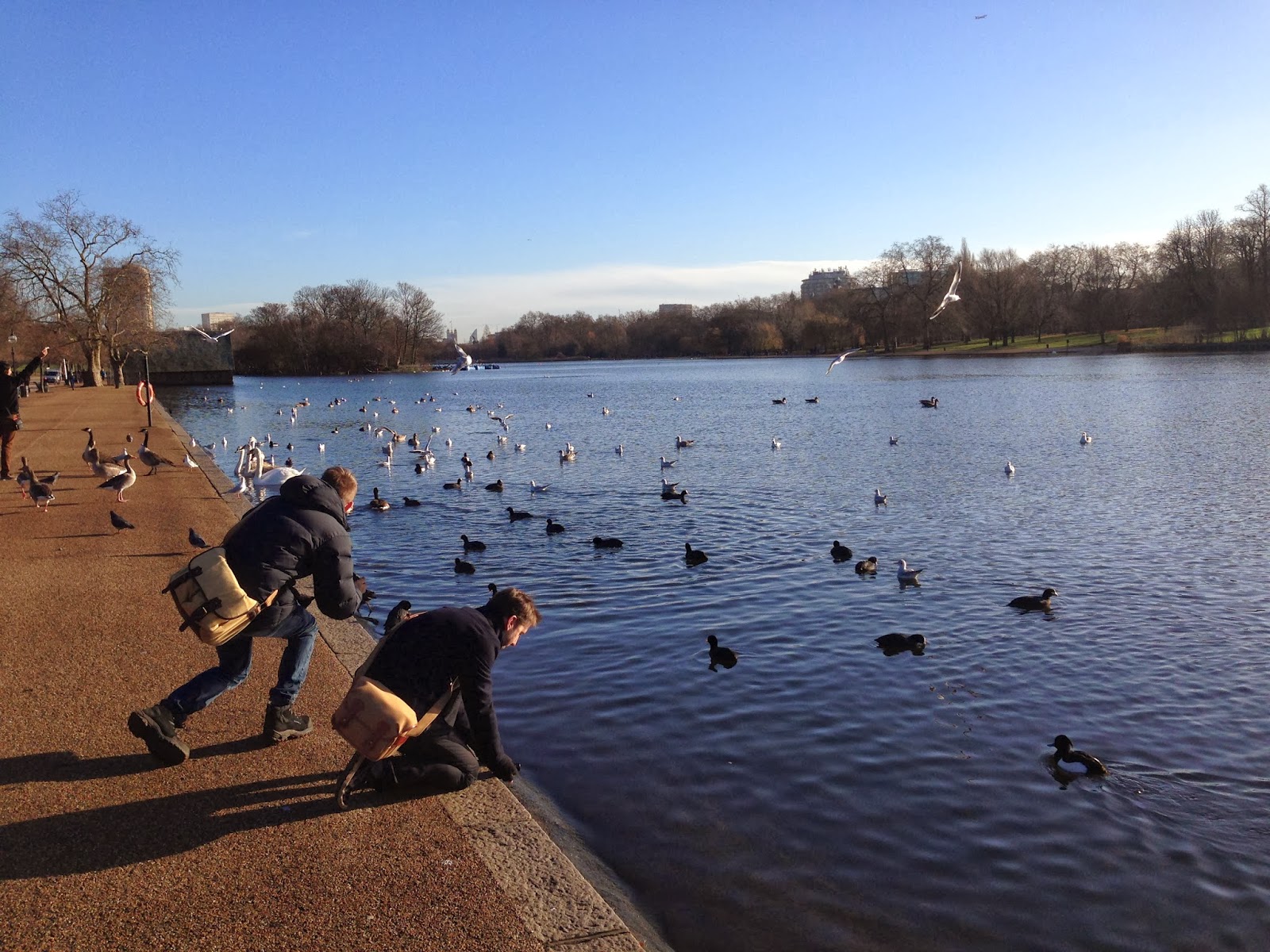
What a gorgeous day this morning was. Indeed, the afternoon was pretty good too. Blue skies, a touch nippy it had to be said. Today was the day that I led a Urban Birding Masterclass sponsored by Leica Mayfair Store. They gave the participants a lush pair of Ultravids to use for the duration of the session.
 Greylag Geese
The group and I scored the usual suspects like Mistle Thrush, Blue, Coal and Great Tits plus Long-tailed Tit. The best find was a lovely Nuthatch that stood out in the open preening.
 Shooting waterfowl
 Birding by the water's edge
Crowd shot